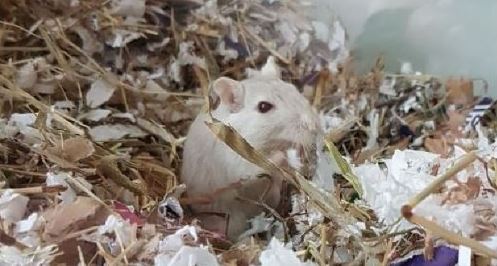
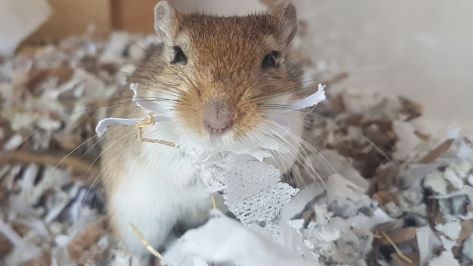
Gerbils are just like us: they’re social animals and thrive in groups. Other than those rare occasions when a Gerbil is forced into solitude (serious infectious illness, de-clanning or waiting for a suitable partner), your Gerbil should never be left alone. It may appear “ok” to you, or you may think “my Gerbil seems happy on their own” or “it might be stressful to get them a partner” but the reality is your Gerbil will quickly become lonely and depressed. Leaving a Gerbil alone is cruel in the same way it would be cruel for you to have to no human contact.
Introductions should only be done using the split cage method. You can only introduce Gerbils safely using this method. Never introduce in neutral territory or into established groups, as this risks serious injury or death. While some will claim success using other methods, you want to maximise your chance of success and avoid injury. No Gerbil “prefers” to be alone, is too aggressive, or shouldn’t be with other Gerbils. All Gerbils (even the difficult ones!) will happily find a new partner eventually.
- Safe pairings include one female–female, male–male, or neutered male–female.
- One young pup (under 8 weeks) can be introduced easily to one same-sex adult with minimal split caging as the youngster will accept the elder in a parental role and has not yet reached adult maturity. By keeping their ages +/- 6 months one is not left alone too long when the other passes in old age. Sexual maturity in Gerbils can be reached after 70 days (10 weeks), which is why to be safe, 8 weeks is the max for minimal split caging, after that age they should be bonded as an adult (below).
- Do not pair two pups with a single adult, as Declanning & Fighting may occur during adolescence when the youngsters challenge the older Gerbil for dominance (around 6-8 months). If you have a bonded group like this, don’t split them up initially as they may be perfectly harmonious (see our Company – Gerbil Care page) but watch them very carefully for potential signs of a de-clan.
- Pairs are the most stable groups—females do best in pairs, males in pairs or can work in small groups up to four (but should ideally split into pairs). Other combinations are possible but must only be attempted by someone very experienced. There is more information about Gerbil group sizes here Company – Gerbil Care .
Where to find Gerbils? See our Adopt Don’t Shop – Where Can I Find Gerbils page.
Gerbil Owners UK have a separate group for putting you in contact with people with Gerbils for bonding or re-homing Gerbil Rehoming & Rescue UK | Facebook
For those based in the South East of the UK, Croydon Small Pet Boarding, https://www.facebook.com/croydonsmallpetboarding/ offer a fee based bonding service.
Creating your split cage
The aim is create a tank or cage split in two halves with a secure mouse wire frame divide, so the Gerbils can familiarise with each other’s scent (your split cage will be very basic, as the Gerbils need to focus on each other). You can use a small hamster cage, a tank, or any enclosure that will allow you to split it in two securely, and make sure the Gerbils do not have too much space. Ideally 60 x 30cm, and no larger than pictured which is 75 x 45cm floorspace. If you have a very large tank section off part of it, before splitting in two to reduce the space. You will need to construct a divide from mouse wire and wood (a diagonal divide is more secure than a straight one), plus a temporary mouse wire lid (simply fold the wire into shape). Gerbils are excellent climbers and the lid will prevent them from climbing over the divide.
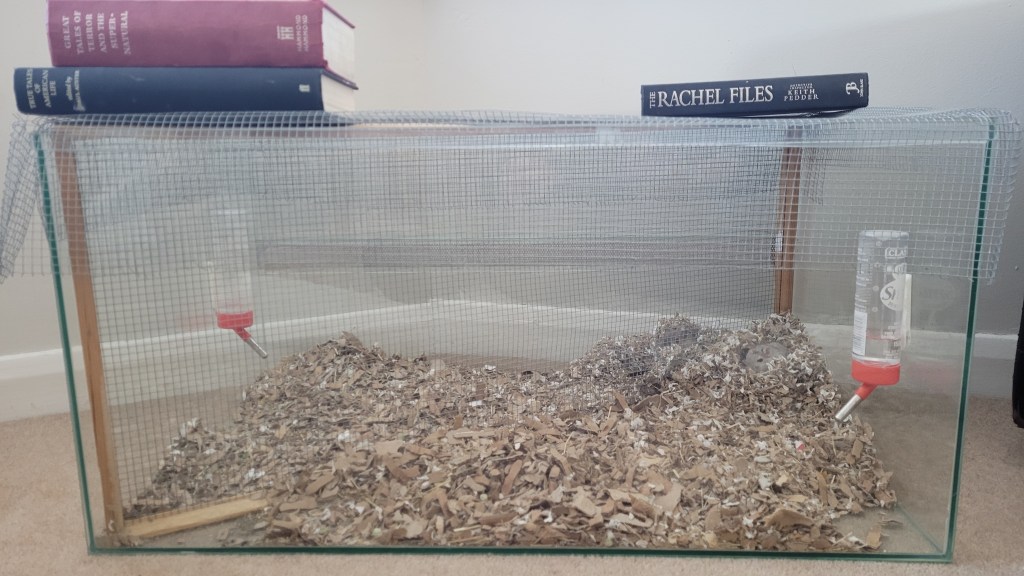
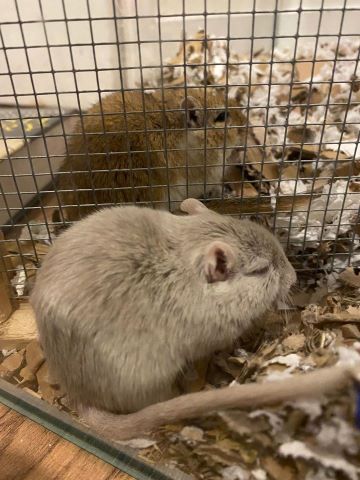
Pictured is a typical split cage with Yuki & Kyo, in this instance using the glass bottom of a tank. For the split cage lid, we’ve just folded some mousewire into shape to allow ventilation and secured with books.
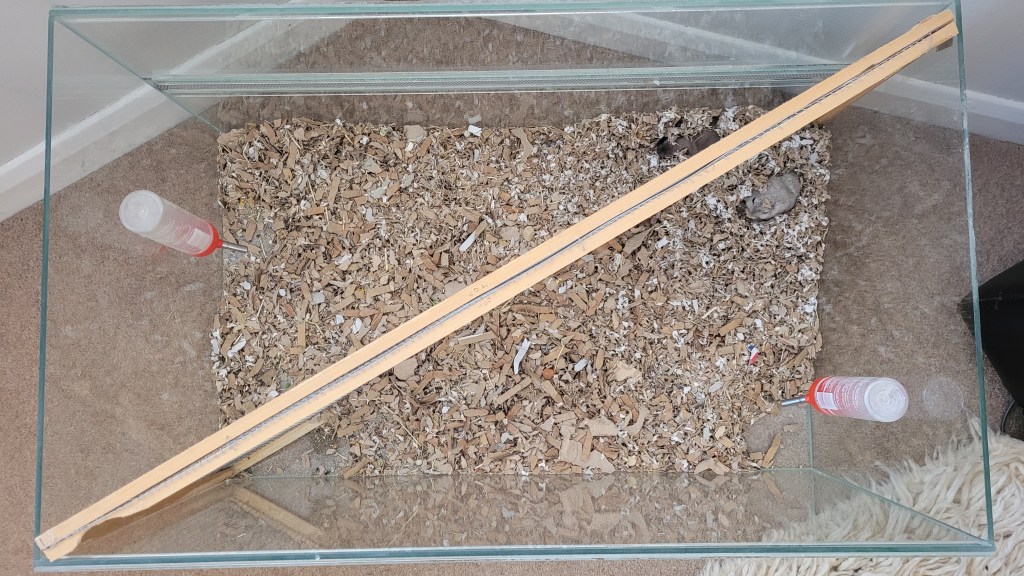
Yuki & Kyo and an aerial view of the split cage with the divider in place. The divider which is mouse wire sandwiched between strips of untreated wood.
Setting up your split cage
- Use 1-2 inches of substrate. Make sure it’s not deep enough for them to burrow or hide away.
- Ensure the divider is sat on the bottom of the tank and not resting on any substrate. Gerbils can push themselves under it or potentially injure themselves if it’s not on the tank base.
- Scatter food for foraging on either side.
- Do not provide food bowls, sand bath or toys, otherwise, Gerbils will become territorial over items. If they need to grind their teeth, they’ll happily use the wood frame. Toilet rolls / cardboard items, which they love to chew through, are ok and will keep them entertained as they are quickly demolished.
- Fix a water bottle to either side either with heavy duty velcro to the glass or secured with wire attached to the divide. You can also use a small water bowl as a back up water source.
- Drop in some sheets of unbleached, plastic free, unscented toilet paper so each Gerbil can make a nest.
- Make sure the lid is on securely (place some books on top, so they can’t climb over the divide).
- Swap the Gerbils over to a different side once a day. Why once a day? This is so they sleep on a different side each night and familiarise themselves with each others scent, but remember every time you handle them you transfer your scent on to them, so limit this to once. Aside from freshly scattered food and water, and topping up toilet paper for their nests, this is all you need to do each day.
- NOTE: As tempting as it may be to handle your Gerbils or give them toys, don’t. Do not clean them out or interfere with the set up. Do not let your Gerbils out for a “play”. Gerbils familiarise themselves by a very keen sense of smell and scent, by adding scents from you and other environments, you could jeopardise the success of the bond.
How long will bonding take?
Bonding can take anywhere from 2 weeks to a couple of months.
Bonding
You’re aiming for your Gerbils to have nothing else to do but focus on each other and their scent. Don’t worry if there are signs of aggression to begin with. It’s perfectly normal. If all goes well, they will happily sleep in each other’s nest, close to each other across the divide. This process will take a minimum of 2 weeks. Look out for these positive signs:
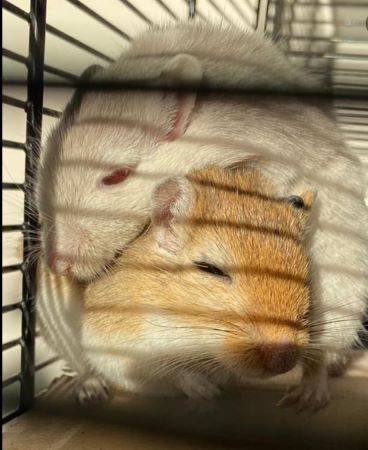
- Sleeping side by side in each other’s nests.
- Keeping close to each other across the divide.
- Grooming or checking in “nose bumping” each other through the divide.
- Eating next to each other across the divide.
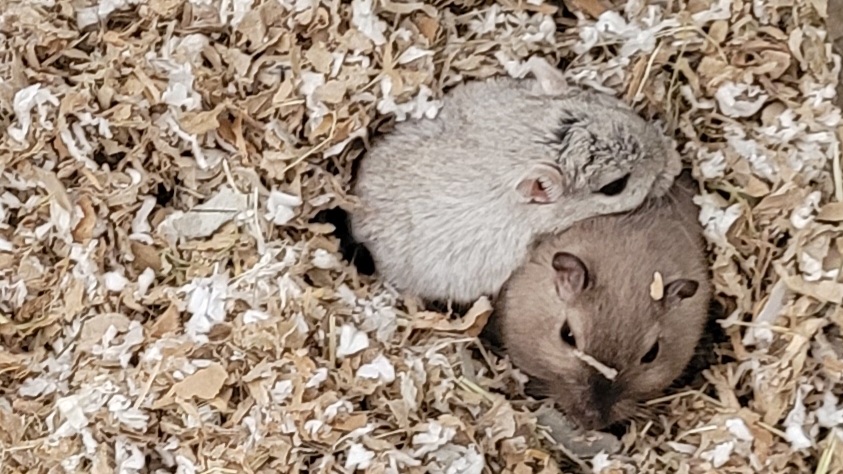
When you’re ready to introduce the Gerbils, swop them one last time 2 hours before the barrier lift, so that no Gerbil has dominated a side of the tank for more than 24 hours. Lift the divide, but be ready to separate if there are any aggressive signs. Make sure you are wearing heavy duty gardening gloves to avoid getting bitten. You may see your Gerbils ‘boxing’ (batting at each other on their front paws), don’t worry, this is totally normal behaviour, as is light chasing, and squabbles. Grooming is a very positive sign, as is snuggling up together and being relaxed. Do not take your eyes off them for the first 3 hours, and put aside a day to monitor your Gerbils. Once your Gerbils are sleeping together, success, your Gerbils have bonded!
Your Gerbils have bonded, what now?
If the bond is successful, keep their set up exactly as is it for 2 days, do not introduce anything else except food and toilet roll sheets for so they can create their own nesting. Carefully add neutral items, i.e. Day 3 a Sandbath, Day 4 a Nest Box, Day 5 a chew toy, Day 6 a wheel etc. Slowly build up the items and the substrate depth over the next 2 weeks. You don’t want to introduce change too quickly. Do not clean them out until their next clean out date. Please see our page on cleaning.
Your Gerbils are NOT bonding, what now?
However, if you see a Gerbil constantly chasing the other without doing anything else (eating, grooming or digging), or forcing the other to bang against the enclosure in an attempt get away, or side-arching (arching up to making themselves appear larger), you will need to intervene. If you see two Gerbils attempted to lock into a “Death Ball”, which is a fast and furious attack, where they will be attempting to bite each other, you must separate immediately (wearing gardening gloves). All is not lost, we have successfully bonded Gerbils for life, after a quick separation at the start of a “death ball” with no injury, so repeat the bonding process above for a minimum of another week (ideally two), and give your Gerbils more time to bond. If the Gerbils continue to fight after 2-3+ attempts, you have a rare situation where the Gerbils may never bond, and you will need to look for new partners.
While the majority of bonds are successful, there will be some Gerbils who will not get on with each other and will need to find another partner, but by using this method, you have the best chance of success, and have helped out two lonely Gerbils.
Important: If any Gerbils are injured, i.e. blood has been drawn, please make sure they are taken to the vet who can clean their wounds and give you the appropriate pain killers and anti-biotics.
 Gerbil Care