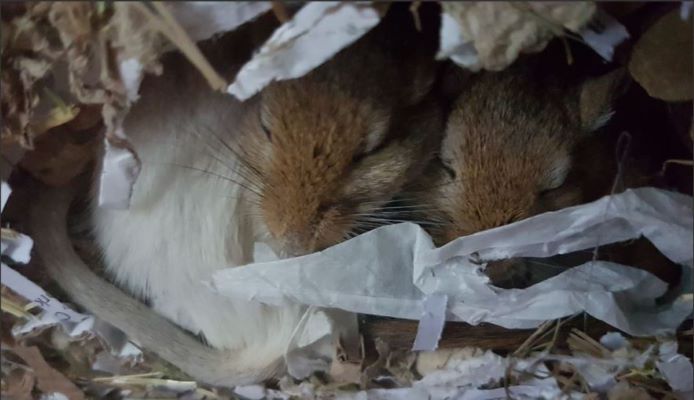
In the wild, Gerbils may fight for dominance in their clan, resulting in the losing party being forced out of the clan to form their own. Occasionally, in captivity, your Gerbils may “de-clan” if one challenges the Alpha Gerbil (the leader of the group). Unlike in the wild, your losing Gerbil cannot just leave the tank to find safety from attack, so look out for these tell-tale signs your Gerbils may be about to de-clan:
- Your gerbils are no longer sleeping together
- The dominant alpha Gerbil is constantly and aggressively chasing another (or vice versa if another Gerbil is challenging for power).
- The ferocity of the chasing is causing them to bang against the side of the tank.
- There are wounds on the attacked/submissive/losing Gerbil (typically around the rear where it has tried to escape)
- One Gerbil is pinning the other to the ground
- There is agressive shoulder barging
- A Gerbil is cowering from the others
- Side arching is a bad sign (a Gerbil trying to make itself appear bigger, like a cat would do).
- There’s blood on the Gerbils or in the tank
- One Gerbil is preventing another from eating or drinking (known as resource guarding)
Some form of dominance is completely normal and you may see your Gerbils engaged in minor chasing, play fighting (boxing & batting) and “humping”. However, if you notice any of the above signs escalating, you must take action. A cheap indoor motion activated security camera that has good night vision is very good for monitoring your Gerbils.
Why have my Gerbils started fighting?
Here are a few reasons why they might not be getting on, plus steps you can take to lower the odds of a de-clan in future. The below may not result in a de-clan, but many of these reasons can.
- Are the Gerbils going through adolescence and asserting their dominance (typically around 6-8 months)?
- Do you have too many Gerbils together? Gerbils ideally should be kept in pairs. Males should not be kept in groups larger than 4 at an absolute maximum, but even that should be avoided, as you are encouraging the chances of a declan for no other reason than there are more Gerbils so more chance of one challenging for Alpha status. This is not to say groups cannot be harmonious and for more information about Gerbil group sizes is here Company – Gerbil Care
- Is there a section of the cage that is easily defended and blocked off by 1 gerbil (e.g one small entrance).
- Are the Gerbils able to resource guard, food and water? If so, remove food bowls, scatter feed and provide two water bottles.
- Is there Illness of the dominant gerbil (making them weaker, and so can be challenged by the other gerbil(s)?
- Have they been separated for too long? I.e. a vet visit for only one Gerbil? If one Gerbil goes to the vet, take them all together.
- A sudden and large increase in cage size (even when the old bedding is transferred). When Gerbils initially move to a much larger tank, do not allow them to have the whole cage area, but section it off and open it up gradually over a few of weeks.
- Is the fighting happening more during free roam time? Some Gerbils get territorial over the extra space so you will have to halt this temporarily until arguing stops.
- Did you fully clean their tank and not replace 20% of the old bedding to keep the scent familiar, causing them not to recognise each other?
- Is there any change to the scent of the room? For instance, has it recently been painted? Are there any new pets in the area? Anything new, i.e. a plant or flowers, air freshener?
- Are you using second-hand toys that have the scent of another pet?
- Are they exposed to ultrasonic interference? Too close to a TV, laptop, radio, fridge freezer, running water etc? This is stressful for Gerbils.
- Have you completely changed their setup recently?
- Have you provided too many nesting areas, coconuts, boxes & hides allowing the Gerbils to sleep separately? Provide only one nesting box.
- Do you have a tank with multiple compartments which can cause territorial behaviour? Avoid any tank with connecting tubes, separate areas, levels or toys that a Gerbil can claim as its own. Keep it simple.
- Do you have a tank with multiple levels which a Gerbil can claim as their own? Gerbils need length not height, plus high levels are dangerous for them.
- Is their tank not set up correctly (see our Cleaning & Tank set up section).
- Are they getting territorial over certain objects? Can you provide them with 2 of everything? For example wheels and water bottles.
My Gerbils have fought, what do I do?
If NO blood has been drawn?
If your Gerbils have fought, but no blood has been drawn, then do not separate them for the time being. Sometimes play fighting, boxing, batting, humping etc can be mistaken for a full blown fight for dominance. If you separate them for up to a 48 hours or even as short as a few hours, you could then end up with 2 single Gerbils, in separate tanks, both in need of being re-bonded together which can be a lengthy process with no guarantee of success. A full blown fight is known as a “death ball” where two Gerbils will be locked together, and a lot of blood will be drawn with obvious injuries, sometimes in a fight to the death. In this instance they must be separated immediately!
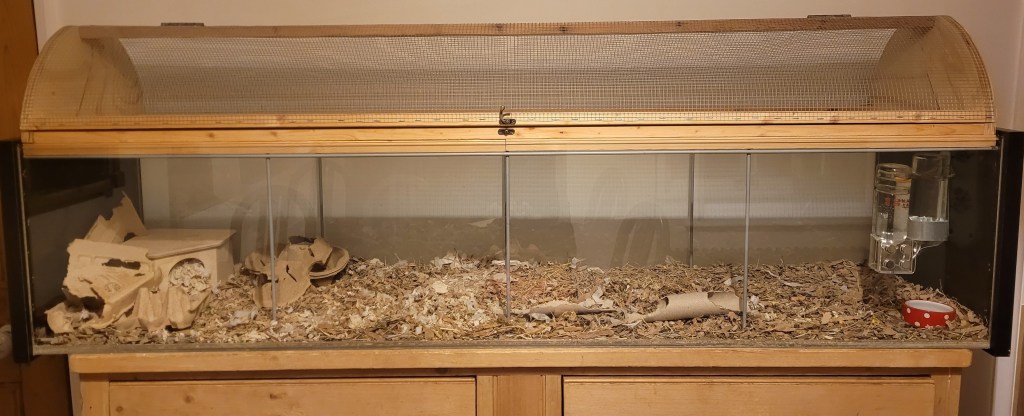
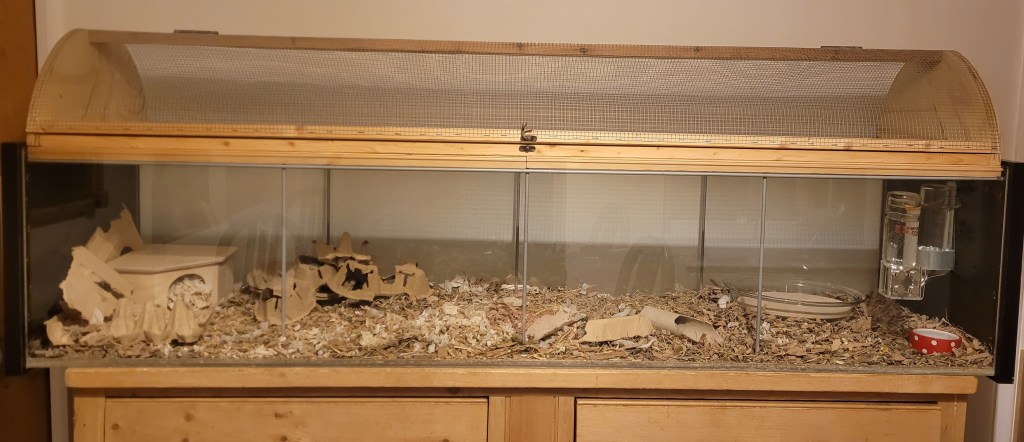
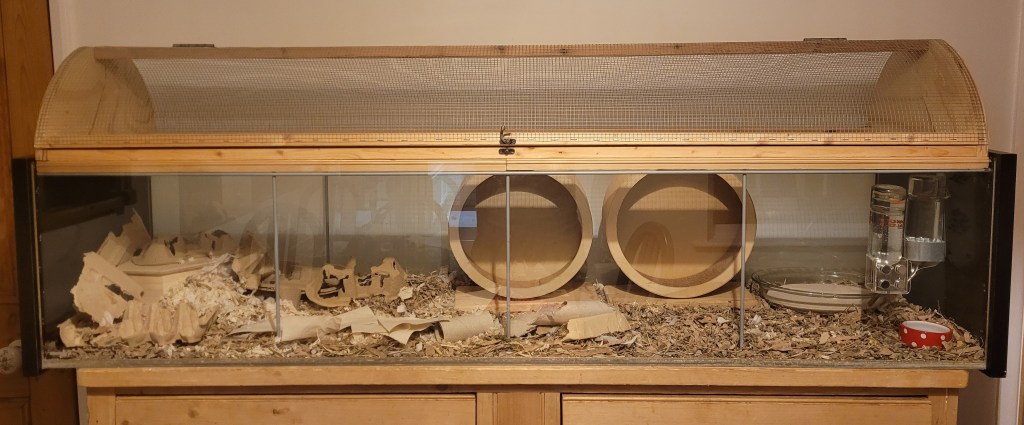
Firstly, eliminate all the possibilities above, stop their free-roam time temporarily and monitor their behaviour. If there is still no improvement, strip the tank right down to bare basics – like a bonding set up. You are doing this to give your Gerbils nothing to be territorial over, and encouraging them to sleep together due to no other options. Use only an inch of substrate, one nesting box, 2 water bottles and scatter nesting material, and food for foraging. This is the same as the split cage setup (but without the divide and includes a nest box). Leave them like this for at least a week, hopefully sleeping together, and interacting without any aggression, then gradually add items a week apart, i.e a sand-bath then a wheel etc. Do not resume free-roaming until they have stopped arguing. If you see tensions escalating, you can as a last resort add a divide and follow the bonding process.
Male Gerbils can be neutered to calm their behaviour (which we have had done successfully) but they are classed as exotic pets, so you will need a specialist vet. While we don’t advise keeping groups this large, but for groups of 4+ we would recommend pre-empting the situation, and splitting them into small groups before fighting occurs, separating the two fighting (dominant) Gerbils into different groups.
Example: Freddie & Markinakis, bonded 2 year 3 month old male Gerbils, started to argue out of the blue, i.e. light chasing and Marinakis pinning Freddie down while attempting to bite him. Marinakis has always been the alpha Gerbil, but was needing to re-assert his dominance due to a challenge from Freddie. Before tensions escalated we eliminated all the possibilities above, stopped their freeroam time (too much area and items to be territorial over) and stripped back their tank. The reason for this is to give the Gerbils very little to be territorial over, not much stimulation, and with only ONE nest box so they are forced to sleep close together and re-bond and re-establish their hierarchy. Very slowly, over a period of 6 weeks, we added items back in. This is similar to how you would re-build a tank after a successful Bonding


My Gerbils have fought, what do I do?
If blood HAS been drawn?
We have managed to keep a pair of Gerbils together harmoniously for life, after a single isolated bite, but only because there were no obvious escalation signs before or afterwards, and they continued to behave as a bonded pair would. The Alpha bit the Beta Gerbil, and in this instance whatever caused their hierarchy issue was quickly resolved between them and the Alpha continued to be in charge. We stripped down the tank as shown in the above example with Marinakis and Freddie, watched their behaviours, and used a motion activated indoor security camera to monitor them closely. We would only advise this if you are experienced, and very confident that tensions are not obviously escalating. If they continue to display any of the declan signs we list above, they must be separated.
A full blown fight is known as a “death ball”, it will be obvious to witness, where two Gerbils will be locked together in a frantic circle, and a lot of blood will be drawn with obvious multiple injuries, sometimes in a fight to the death. If this has happened they must be separated immediately.
For a pair of Gerbils, you will need to separate them permanently and each Gerbil will need to be re-bonded with a new partner. If they are young enough (i.e. 8 months or under), you can easily bond with ONE young pup 6 – 8 weeks of age (no older), as the pup will not have reached adolescence, and will take to the adult who will provide a parental role. It means when one passes in old age, the other won’t be alone for too long if you’re unable to find a suitably old partner to re-bond with. Ideally, for pups, you would contact you local rescues first, and while we don’t promote breeders on this site, you are most likely to be able to reserve a young Gerbil through a reputable one. Most Gerbils in pet shops (which we do not promote the use of) are 12 weeks or older.
For a group of 3 Gerbils, remove the submissive/attacked/losing Gerbil. The reason for this is the Alpha Gerbil has already established its dominance in the group, and removing the Alpha would create a power vacuum. In the wild the loser always leaves the clan and it should be no different in captivity. Your remaining Gerbil will need to be re-bonded as above.
For a group of 4 Gerbils or more, divide them into pairs (or small groups), do this immediately, as after 48 hours, to as little as a couple of hours, Gerbils can forget each others scent and need to be re-bonded, which may or may not work, causing more complications. When dividing into groups, make sure the Alpha Gerbil is in a separate group to the submissive/attacked/challenging Gerbil. You can usually tell the submissive/attacked/challenging Gerbil as it will have come off worse, and likely has bites around its rear where it’s tried to escape.
Your final option, and if you do not have suitable space and housing for separate groups of Gerbils, is to contact your local Rescue Centre and rehome your single or additional pair. You must check the Rescue Centre has a policy of only rehoming singles into bonded pairs. Similarly you can advertise privately (always charge, never free, due to unscrupulous people scouring free ads for free reptile food) but be vigilant that the new home has an existing single Gerbil and suitable housing, with a promise to take back your Gerbil if the bond is not successful. Gerbil Owners UK have a separate group for putting you in contact with people with Gerbils for bonding or re-homing which is Gerbil Rehoming & Rescue UK | Facebook
If at any point you are left with a lone Gerbil, you must re-bond them with a new partner. Your local Rescue Centre may be able help you source another lone Gerbil. Remember to only follow the split cage method. More information is here as to how to re-bond
Some form of dominance is completely normal and you may see your Gerbils engaged in minor chasing, play fighting (boxing & batting) and “humping”. However, if you notice any of the above signs escalating, you must take action.
Always seek immediate vetinary treatment if your Gerbils have been injured.
While these fights are uncommon, and Gerbils are usually very sociable, be aware that Gerbils will fight to the death in some rare situations.
 Gerbil Care